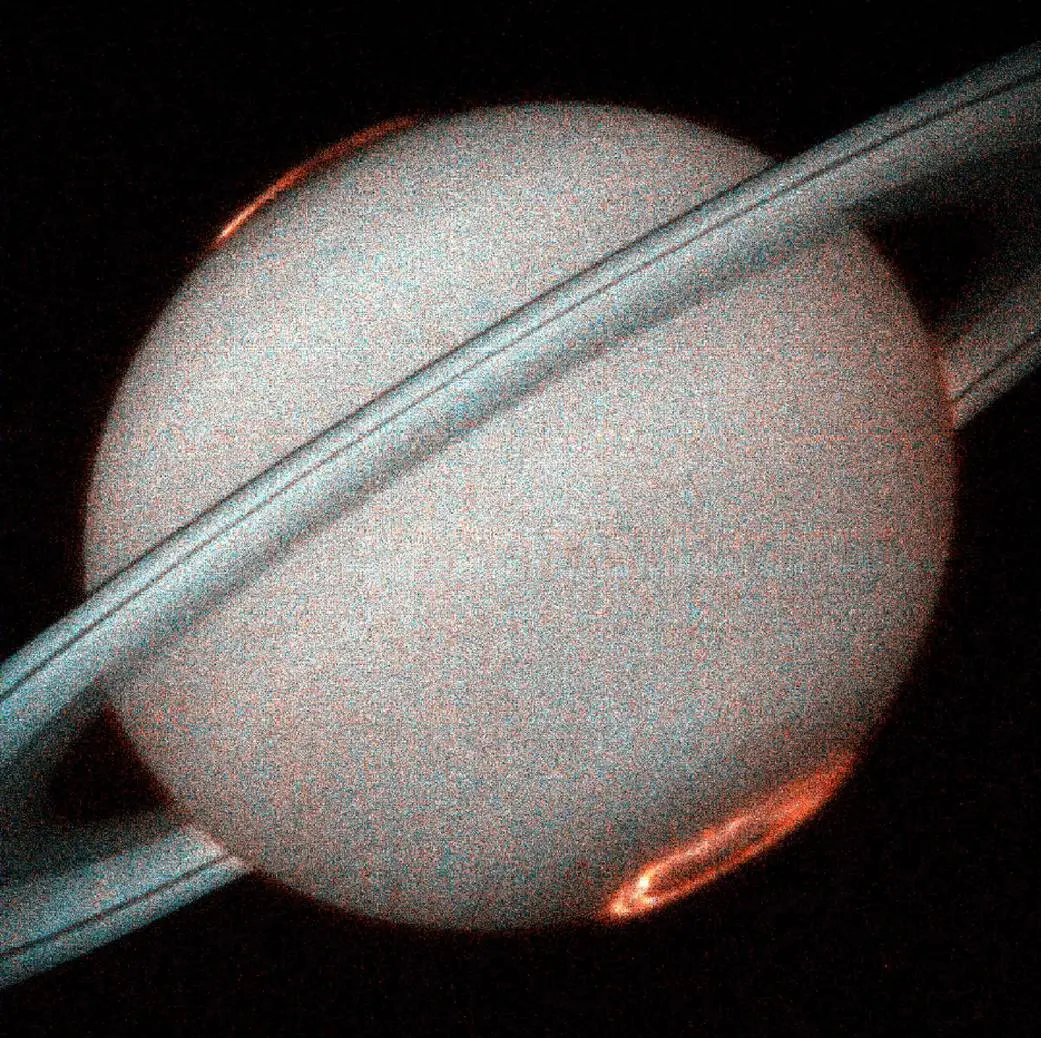
Magnetic fields are the closest humanity has come to magic. It is an invisible field which despite doing no work has a profound effect on everything. Take the Earth’s magnetic field for example. Without it, the solar wind would have fried this planet sterile. Plausibly then, we might imagine that planetary magnetic fields are key ingredients of planetary habitability. Other planets like Jupiter and Saturn in our solar system poses magnetic fields as well. We can attest to that for a variety of reasons, but the most visually impressive one is Aurorae (Northern Lights) on their poles, as seen in the image below.
Aurorae are visible not only in the optical wavelengths but also in the radio. An exoplanet (planet outside our solar system) with a strong enough magnetic field could induce an Aurora strong enough to be detected from the Earth.
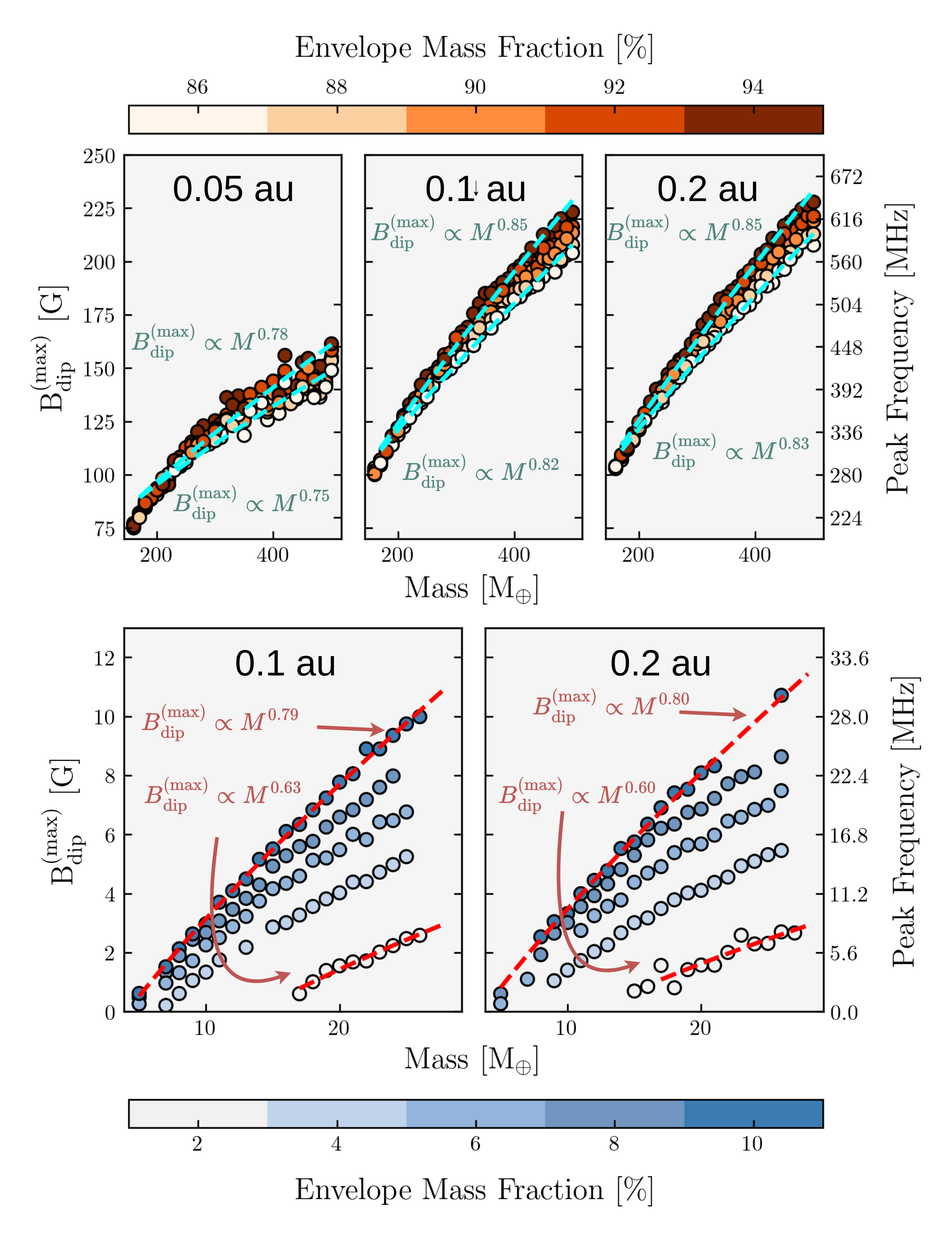
With these thoughts mind, we used MESA to simulate planetary atmospheres and interiors. We focused our efforts in Jupiter and Neptune like planets close to their parent stars. We aimed to study the interplay between strong stellar irradiation and the convective motions in the interiors of planets that result in magnetic fields. Knowing how the planets interior evolved, we could calculate the expected strength of the magnetic field and from that in which frequency we could detect the Aurora.
The results of our numerical experiments are summarized in the figure above. We found that larger atmospheric envelopes, that is more of the planet’s mass being gaseous rather than in a metallic core lead to stronger magnetic fields.
This project was undertaken together with Aline Vidotto, Andrew Allan and Darya Kubyshkina. The publication (Kilmetis et al., 2024). that came out of it was awarded the MNRAS 2025 Student Author Prize.
References
2024
MNRAS
Magnetic fields of hot Jupiters and hot Neptunes: Evolution and Detection Prospects
K.
Kilmetis, A. A.
Vidotto, A.
Allan
, and
1 more author
Numerical simulations have shown that the strength of planetary magnetic fields depends on the convective energy flux emerging from planetary interiors. Here we model the interior structure of gas giant planets using MESA, to determine the convective energy flux that can drive the generation of magnetic field. This flux is then incorporated in the Christensen et al. dynamo formalism to estimate the maximum dipolar magnetic field of our simulated planets.
First, we explore how the surface field of intensely irradiated hot Jupiters ( 300 Earth Masses) and hot Neptunes ( 20 Earth Masses) evolve as they age. Assuming an orbital separation of 0.1 au, for the hot Jupiters, we find that the maximum surface magnetic field evolves from 240 G at 500 Myr to 120 G at 5 Gyr. For hot Neptunes, the magnetic field evolves from 11 G at young ages and dies out at ≳2 Gyr.
Furthermore, we also investigate the effects of atmospheric mass fraction, atmospheric evaporation, orbital separations αand additional planetary masses on the derived maximum surface field. We found that it increases with αfor very close-in planets and plateaus out after that. Higher atmospheric mass fractions lead in general to stronger surface fields, because they allow for more extensive dynamo regions and stronger convection.
Finally, we show that potential auroral emission from hot Jupiters and very young hot Neptunes could be detectable with ground-based radio observatories.
@article{exomag24,title={Magnetic fields of hot Jupiters and hot Neptunes: Evolution and Detection Prospects},author={Kilmetis, K. and Vidotto, A. A. and Allan, A. and Kubyshkina, D.},year={2024},publisher={Monthly Notices of the Royal Astronomical Society},}