Neutron Stars
Interiors, mostly
The thing that fascinated me first was Neutron Stars. It is kind of impossible to not be fascinated by them. When one first encounters them as an undergrad, they are greeted with a picture like the following one.
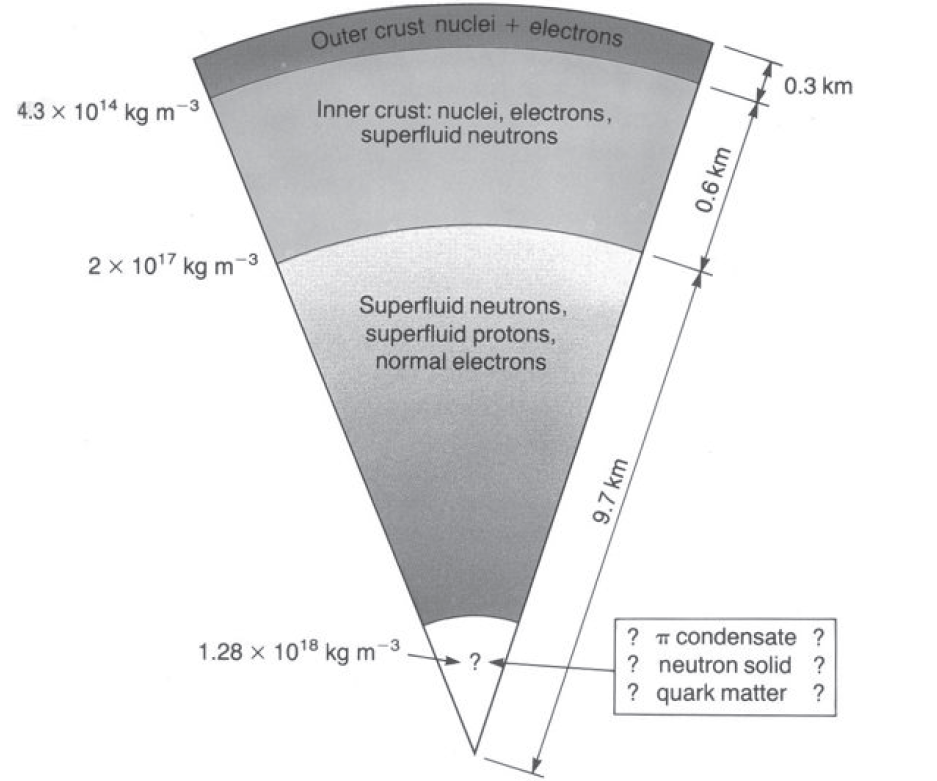
There is a literal question mark there. This direct admission of ignorance is very rare in the early years of a Bachelor. It was the first time when Physics transitioned from understanding immutable laws to exploring what might be.
I was very eager to undertake any research regarding Neutron Star interiors. To try and understand why there was a question mark there. Depending on what actually is inside a neutron star, the relation that dictates its thermodynamic properties, the Equation of State (EoS), changes. By numerically integrating the EoS alongside the rest of the equations that describe a neutron star, the allowed masses and radii for each EoS can be calculated. By comparing the predicted maximum mass with the observed ones, some EoS can be falsified.
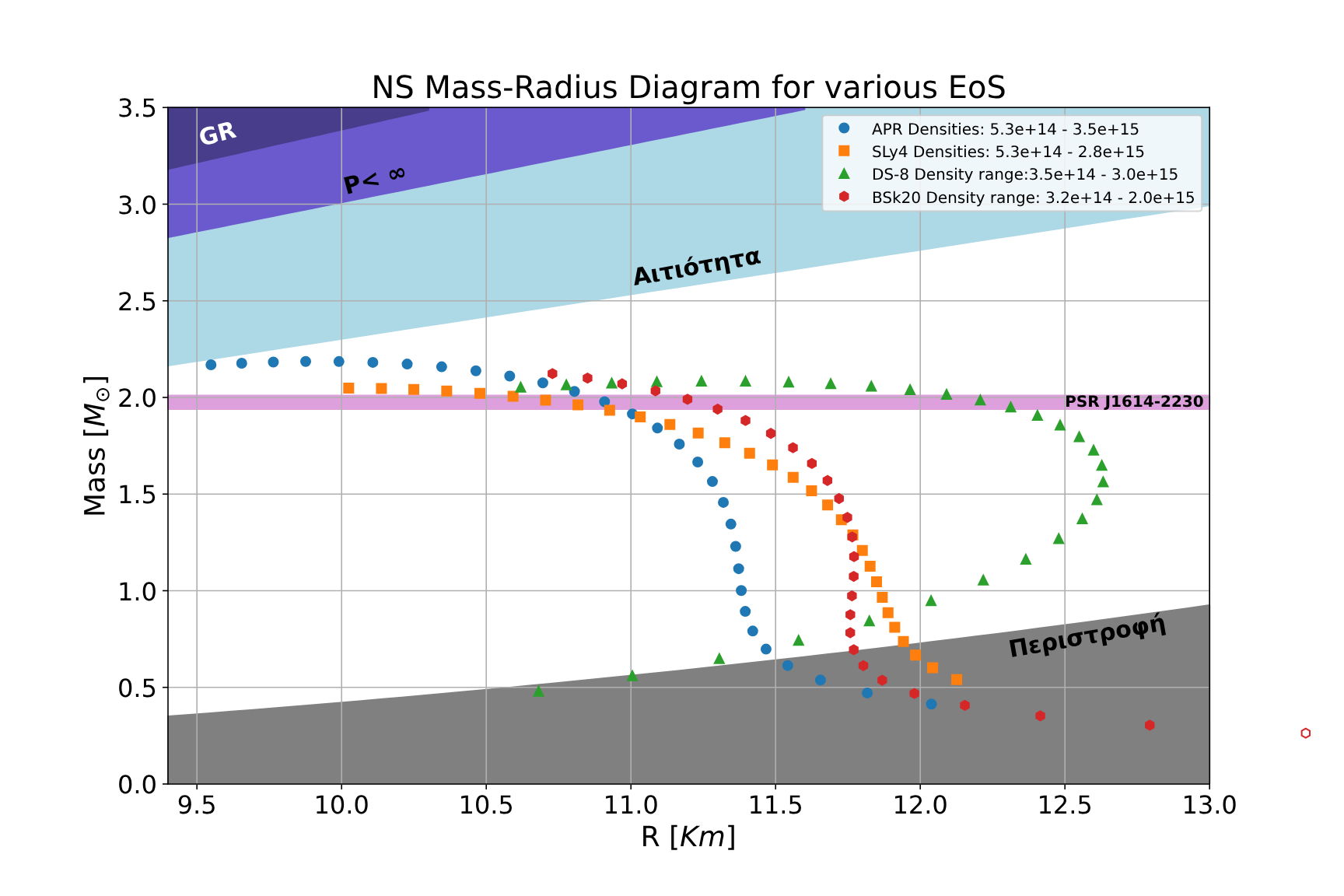
In the figure above (sorry for the Greek), each EoS state, marked by different colors, is integrated for a given core density. All four EoS cross the pink line, the heaviest neutron star observed at 2022, when this plot was made. No neutron star may exist in the colored regions, they are forbidden either because of extreme rotation taking the neutron star apart, causality etc.
This project was done under the supervision of Apostolos Mastichiadis and Danai Antonopoulou. Without the latter, I wouldn’t have pursued research. After its completion, I undertook an internship in the Observatory of Athens, under Manos Saridakis and Fotis Anagnostopoulos. There, we flipped that project on its head, using one EoS and swapping out the other equations which describe gravity. That way, we could falsify gravity theories instead of EoS. Unfortunately, we did not complete that project as I had to move to the Netherlands for my Masters.