TDEs
Black holes still have to eat
Tidal disruption events, -hereafter TDEs- involve a star being knocked into an orbit which approaches lethally close to a black hole. When the star gets too close, the gravitational force that keeps it together is overwhelmed by the tidal force of the black holes gravitational field. The point closest to the black hole is pulled towards it while the point further is pushed away. As the star continues to orbit, this leads to a characteristic spaghetti-esque configuration.
After the encounter, each piece of the star is endowed with a slightly different energy, leaving half of them bound and half of them launched to space. The bound part returns to the black hole, rapidly loses its energy and is accreted. The movie below shows just that, the stellar debris returning to the black hole at (0,0). It is made from one of the simulations I post-processed.
This process generates supernova-level of light. Indeed, it is one of the few ways available for spotting quiet black holes. This is the big picture goal of this work, using TDEs in order to do black hole demographics. The mass distribution of black holes in ill-constrained in the low mass end, as not-too-massive black holes are usually hard to tell apart. That is, unless we catch them in the act of devouring a star.
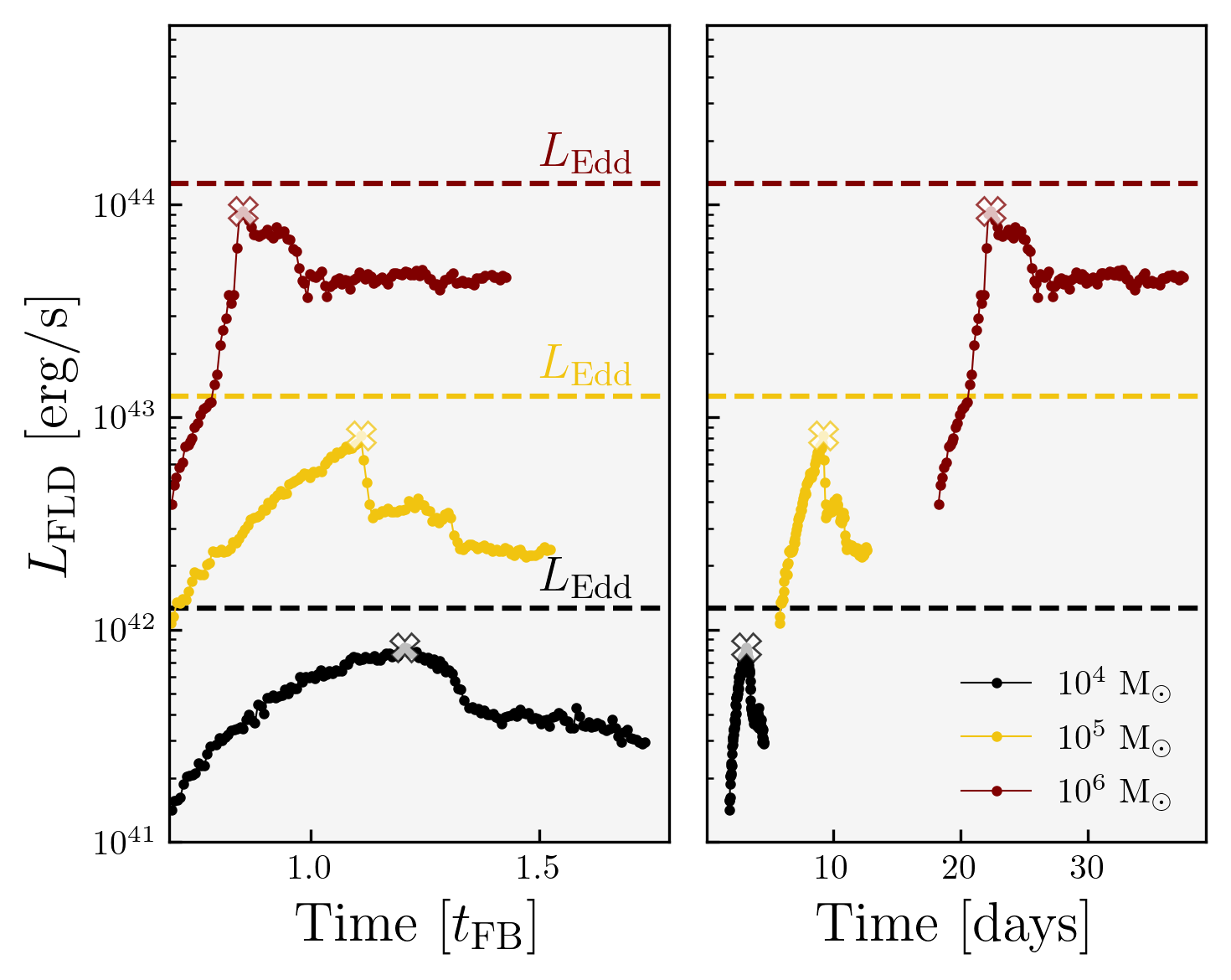
In the figure above, you can see the bolometric light curves (that is across all wavelengths, infrared, optical, ultraviolet, X-rays…) of three TDEs. Each black hole is 10 times heavier than the previous. The star is always half the Sun’s mass. The two panels correspond to dynamical time and real time respectively. A cool thing about TDEs is that they operate across human timescales, something very rare for astrophysical phenomena. However, since we want to make an apples-to-apples comparison between TDEs induced by black holes of different masses, we use a time-scale that takes into account the parameters of each event. In this case, the fall-back time refers to the Keplerian period of the most bound piece of stellar debris. We can see that despite the heaviest black hole taking the longest time to get going, if we account for the scale of the system it actually operates faster than its smaller siblings.
This project was undertaken together with Paola Martire, Elad Steinberg, Nicholas Chamberlain Stone and Elena Maria Rossi. The art on the projects page was done by lovely and extremely talented sister, Iro.